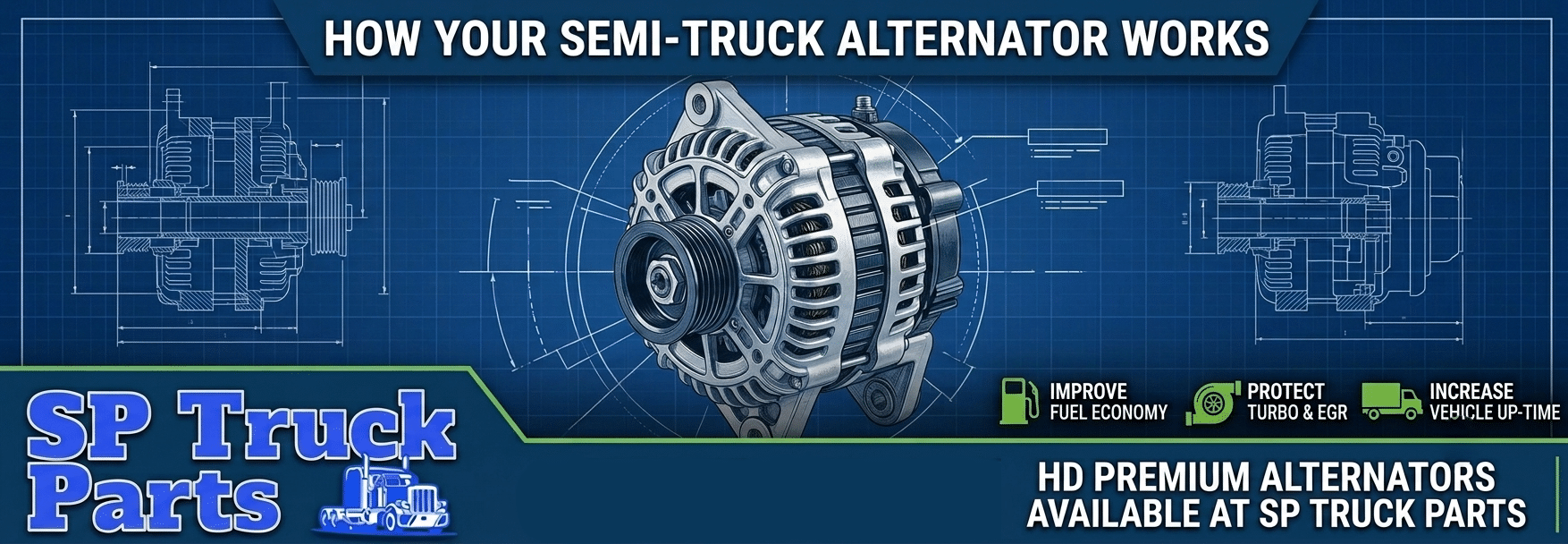
A heavy-duty commercial truck relies on a massive electrical network. From critical engine management systems and electronic logging devices (ELDs) to auxiliary power units (APUs), sleeper climate controls, navigation, and exterior lighting, modern rigs require steady, high-amperage power.
At the heart of this entire system is the alternator.
While many believe the battery bank powers a truck while driving, the battery’s primary job is simply getting the engine started. Once the diesel engine fires up, the alternator takes over, continuously generating electrical power for every onboard load and simultaneously replenishing the battery bank.
How Does a Semi-Truck Alternator Work?
The alternator converts mechanical energy from the truck’s engine into usable electrical energy through electromagnetism:
1. Mechanical Drive (The Pulley & Serpentine Belt)
The alternator is mounted directly to the engine block and driven by the serpentine belt connected to the engine’s crankshaft. As the engine runs, the belt spins the alternator’s internal rotor shaft at thousands of RPMs.
2. Electromagnetic Induction (Rotor & Stator)
Inside the housing, the rotating shaft carries copper-wound electromagnets known as the rotor. As the rotor spins inside a stationary set of three-phase copper coils called the stator, it cuts across magnetic fields, generating alternating current (AC) electricity.
3. Rectification (Converting AC to DC)
Your semi-truck’s electronics, sensors, starter, and batteries operate on direct current (DC) electricity, but the stator produces alternating current (AC). Built-in rectifier diodes act as one-way electrical valves, converting AC power into steady 12V or 24V DC power.
4. Precision Voltage Regulation (The Voltage Regulator)
Because engine speeds fluctuate constantly between idling and highway cruising, the alternator’s raw output changes with RPM. The internal voltage regulator monitors system demands and modulates field current to maintain an optimal charge—typically between 13.8V and 14.4V—preventing battery boiling, blown fuses, and ECM damage.
Symptoms of a Failing Semi-Truck Alternator
Commercial alternators operate under extreme conditions, including high ambient engine bay heat, road vibration, dust, and continuous heavy-amperage draw. Watch for these early indicators of failure:
- Dim or Flickering Lights: Headlights, dash illumination, or trailer clearance lights fluctuating with engine RPM.
- Low Voltage Readings / Battery Warning Light: Instrument cluster voltage gauges dropping below 13.5V during road operation.
- Dead or Constantly Discharged Batteries: Having to jump-start the truck despite having relatively new battery packs.
- Whining or Grinding Noises: Worn internal bearings or diode hum caused by excessive load and heat stress.
- Burning Smell: Overheated insulation on the stator windings or a slipping drive belt.
Why Quality Matters: Upgrade to Heavy-Duty Performance
In Class 7 & 8 commercial applications, an undersized or low-grade replacement alternator will fail prematurely under the thermal stress of hotel loads, refrigeration units, and telematics.
Premium manufacturers like DENSO design heavy-duty alternators engineered specifically for rigorous commercial duty cycles:
- High-Output Efficiency: Robust copper stator windings capable of sustaining high amperage outputs even at low idle speeds.
- Superior Heat Dissipation: Heavy-duty dual internal cooling fans and vented aluminum casings engineered to resist high under-hood temperatures.
- Extended Bearing Life: Sealed, premium bearings that withstand belt tension and long-haul highway vibration.
- Brushless / Heavy-Duty Brush Technology: Minimized internal friction for extended maintenance-free service hours.
Buy Premium Commercial Alternators at SP Truck Parts
Don’t let alternator failure sideline your equipment or leave you stranded at a truck stop. At SP Truck Parts, we carry top-tier, heavy-duty commercial alternators—including premium OEM-grade units from DENSO—built to withstand the demands of modern trucking.